
PUAEME007 – Provide Emergency Care for Suspected Spinal Injury
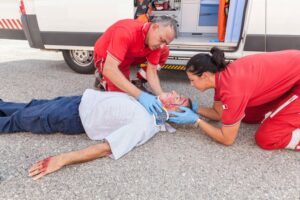
The PUAEME007 – Provide Emergency Care for Suspected Spinal Injury course applies to individuals who may be required to provide emergency care to a casualty with suspected spinal injury. This course is designed to provide the knowledge and skills required to minimise further injury to a casualty, both conscious and unconscious, when applying first aid and waiting for emergency medical aid in a range of situations, including community and workplace settings.
The PUAEME007 – Provide Emergency Care for Suspected Spinal Injury course includes recognition and management of a suspected spinal injury, immobilising cervical spine using manual in-line stabilisation (MILS) techniques as well as spinal equipment, evaluating the need to move a casualty, preparing a casualty for transport, transporting and monitoring a casualty as well as performing a casualty handover to emergency services.
PUAEME007 – Provide Emergency Care for Suspected Spinal Injury course develops the skills to minimise further injury when applying first aid and waiting for emergency medical aid. Our course includes recognition and management of a suspected spinal injury, immobilising cervical spine, evaluating the need to move a casualty, preparing a casualty for transport, transporting and monitoring a casualty and performing a casualty handover.
PUAEME007 – Provide Emergency Care for Suspected Spinal Injury requires instruction and practical training. This is especially true where it relates to potentially fatal injuries, such as those that require cardiopulmonary resuscitation (CPR) or involve severe bleeding. These procedures carry a risk of further injury to the casualty and the first aider. As with any training, it is more useful if training occurs before being confronted with an actual real-life situation.
Important information prior to enrolment
Units Being Delivered
The following unit(s) will be awarded to successful participants in this course. The certificate will be issued by Allens Training Pty Ltd RTO 90909.
To view full unit details please visit www.training.gov.au
Location:
We run our classes at the 54 Cessnock Rd, Weston or in the workplace
Course Duration
Course durations can vary for multiple reasons, so the durations below are the minimum possible amount.
- Refresher: N/A
- Face-to-Face: Face to Face contact time of at least 5 Hours
- Online with Face-to-Face: 2 hours
Entry Requirements for PUAEME007 – Provide Emergency Care for Suspected Spinal Injury
An individual undertaking the PUAEME007 – Provide Emergency Care for Suspected Spinal Injury course with Allens Training Pty Ltd will need to demonstrate the following to be eligible for entry:
- Hold the pre-requisite unit HLTAD011 Provide First Aid
- Physical capability to be able to meet the demands of the practical demonstration skills which includes conducting spinal manual in-line stabilisation (MILS) techniques, kneeling on the floor to perform a log roll as part of a team , assisting a conscious casualty to supine position and using equipment to immobilise a casualty’s spine to transport them away from a hazard
Online study options: The online learning program can be found in the student portal. Students must have access to a computer, smart phone, tablet or other electronic device with access to the internet to complete the online studies and practical assessment.
Assessment Activities
Practical scenarios:
- Assist a conscious casualty with suspected spinal injury into supine position
- Manage an unconscious breathing casualty with suspected spinal injury
- Manage an unconscious non-breathing casualty with suspected spinal injury
Documentation:
- Incident Report
Theory assessment – A written assessment consisting of multiple-choice questions. The student must complete all assessment questions.
Upcoming Courses for PUAEME007 – Provide Emergency Care for Suspected Spinal Injury
*If you cant find a date listed use the form below to make a group booking enquiry
Learners Rights, Responsibilities and Support, including Complaints
Please note that enrolment to this course is made with Allens Training Pty Ltd RTO 90909. Please refer to the student handbook located on the RTO website https://allenstraining.com.au/students/student-handbook for all details relating to rights and responsibilities including complaints and appeals.
Course Fees and Payments
- Please refer to our booking calendar for individual course fees.
- Refund and fee protection policy – Please refer to the student handbook.
- Payment Terms – Payment for individual participants is upfront, group booking payment terms are based on agreement between the client and service provider.
- Group Prices – We do have Group Prices for up to ten or up to twenty participants phone for a quote
Work Placement Arrangements
No work placement will be required as part of this course.
Provider of Training and Assessment
This course “Training and assessment delivered on behalf of Allens Training RTO 90909”
by Safe Act Pty Ltd
PUAEME007 – Provide Emergency Care for Suspected Spinal Injury
The spine is made up of 33 separate bones, known as vertebrae, extending from the base of the skull to the coccyx (tailbone). Each vertebra surrounds and protects the spinal cord (nerve tissue). Fractures or dislocations to the vertebral bones may result in injury to the spinal cord. The direct mechanical injury from the traumatic impact can compress or sever the nerve tissue. This is followed by secondary injury caused by ongoing bleeding into the spinal cord as well as continued swelling at the injured site and surrounding area.
The possibility of spinal injury must be considered in the overall management of all trauma victims. The risk of worsening the spinal injury in the prehospital period is probably less than previously thought, yet to minimise the extent of the secondary injury, caution must be taken when moving a victim with a suspected spinal injury.
Spinal injuries can occur in the following regions of the spine:
- the neck (cervical spine)
- the back of the chest (thoracic spine)
- the lower back (lumbar spine).
The cervical spine is most vulnerable to injury, which must be suspected in any victim with injuries above the shoulders. More than half of spinal injuries occur in the cervical region. Suspected spinal injuries of the neck, particularly if the victim is unconscious, pose a dilemma for the rescuer because correct principles of airway management often cause some movement of the cervical spine.
The most common causes of spinal cord injury are:
- a motor vehicle, motor cycle or bicycle incident as an occupant, rider, or pedestrian
- an industrial accident (i.e. workplace)
- a dive or jump into shallow water or water with obstacles or being “dumped” in the surf
- a sporting accident (e.g. rugby, falling from a horse)
- a fall from greater than a standing height (e.g. ladder, roof)
- falls in the elderly population
- a significant blow to the head
- a severe penetrating wound (e.g. gunshot).
The symptoms and signs of a spinal injury depend on two factors: firstly the location of the injury and secondly, the extent of the injury – whether there is just bone injury or associated spinal cord injury, and whether the spinal cord injury is partial or complete. It will be difficult to elicit symptoms and signs in victims with an altered conscious state.
PUAEME007 – Provide Emergency Care for Suspected Spinal Injury